
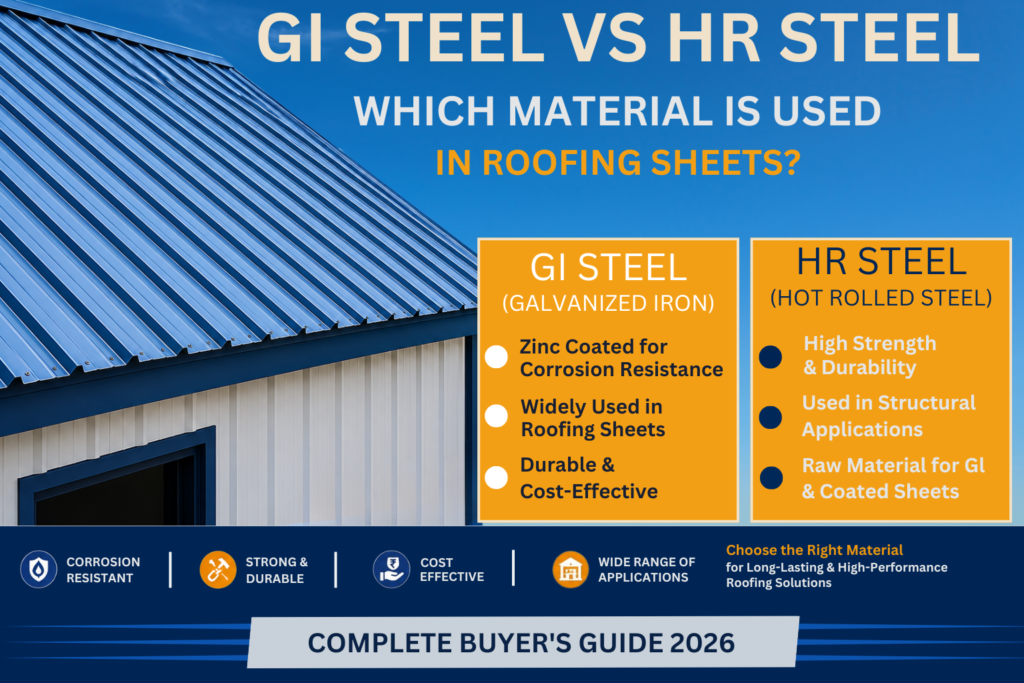
When planning an industrial shed, warehouse, factory, commercial building, or residential house, one of the most important factors to consider is selecting the right roofing base material. Moreover, the choice of material plays a crucial role in determining the roof’s strength, durability, corrosion resistance, and overall performance.
The frequently asked question by builders, contractors, or project managers is, “What is the base material for roofing sheets—GI or HR steel?”
Selecting the best base material for the roof is extremely vital, as it is the base material that determines all the factors associated with the strength, corrosion resistance, thermal insulation properties, aesthetics, and lifespan of the roof. In this comprehensive guide, we will highlight the differences between GI (Galvanized Iron/Steel) and HR (Hot Rolled) Steel, eliminate industry myths, and guide you to choose the exact base material for your buildings.
Roofing Sheets Core Material
The core material of roofing sheets plays a vital role in determining their strength, durability, corrosion resistance, and overall service life. Manufacturers use different steel substrates as the foundation of roofing sheets, and each material offers unique performance benefits. The most commonly used base materials in color-coated roofing sheets include HR (Hot Rolled) Steel, GI (Galvanized Iron) Steel, and advanced coated materials such as PPGL (Pre-Painted Galvalume). These steel substrates play an important role in determining the roofing sheet’s structural strength, corrosion resistance, weather protection, and long-term service life.
HR steel provides high strength and excellent formability, making it suitable for structural applications such as PEB frames, columns, beams, and industrial fabrication. On the other hand, GI steel uses a protective zinc coating that improves corrosion resistance, making it a preferred choice for roofing sheets exposed to moisture and weather conditions. Furthermore, PPGL roofing sheets combine a strong steel core with an aluminum-zinc alloy coating to deliver superior durability, weather protection, and long-term performance.
Therefore, selecting the right roofing sheet core material is essential for achieving a reliable, durable, and cost-effective roofing solution for industrial, commercial, agricultural, and residential projects.
1. GI Steel (Galvanized Steel)
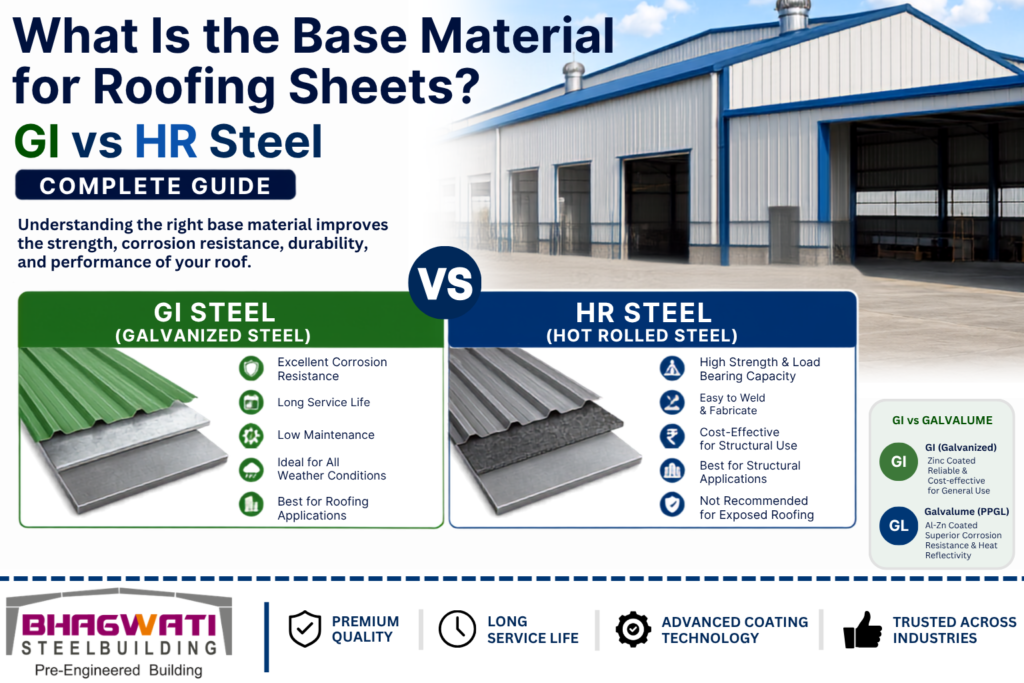
The industry standard for exposed roofing sheets in India is GI steel. It is formed by passing the cold-rolled steel through a bath of molten zinc (hot-dip galvanization). The zinc coat forms a sacrificial barrier which helps protect the underlying steel from water, oxygen and other atmospheric pollutants.
- Advantages: High corrosion resistance, long life span, very little maintenance, smooth surface finish, weather resistant.
- Common Uses: Roofing sheets, wall cladding, rainwater gutters, flashings and agricultural buildings.
- Estimated Life Span: depending on the zinc coating thickness (GSM) and paint quality.
2. HR Steel (Hot Rolled Steel)
Manufacturers produce hot-rolled (HR) steel by rolling steel at temperatures above 1,000°C, which exceeds the recrystallization temperature. This means that HR steel is characterized by good strength, ductility, and formability. The problem of uneven mill scale formation occurs in the course of the treatment. The mill scale is stripped off first before going ahead with any further treatments.
Since there is no coating on the surface of plain HR steel, it tends to corrode very quickly when exposed to water and air. Therefore, galvanization or protective coatings are used in order to protect the metal from corrosion.
- Advantages: Better structural load-carrying capacity, high degree of ductility, easy to weld & fabricate, and very economical for thick gauge sections.
- Applications: Employed as Structural Members in Main/Secondary Structures; PEB Columns, Rafters, Beams, Base Plates, Purlins and Trusses
- Roofing Appropriateness: Not suitable for exposed roofing application. Rusts easily if exposed to the atmosphere when using raw HR steel because of its high susceptibility to corrosion unless treated through the process of Hot Dip Galvanization.
Process Of Making Modern Roofing Sheets
Many people assume that HR steel and GI steel are entirely different products. However, manufacturers produce GI steel by coating HR steel with zinc, making HR steel the base material for most steel roofing sheets.
The Process:
- Hot Rolled (HR) Steel Sheet: Manufacturers produce basic structural steel sheets by rolling steel at high temperatures.
- Pickling & Cold Rolling: First, manufacturers remove the mill scale through chemical pickling. Next, they cold-roll the steel to achieve the required thickness.
- Galvanization / Galvalume Coating: Manufacturers coat the steel strip with zinc (GI) or an aluminum-zinc alloy (Galvalume) to provide excellent rust resistance.
- Pre-treatment and Painting (PPGI/PPGL): Use of primers and high-quality external paints like RMP, SMP, or PVDF, followed by curing through heating
- Roll Forming: The coated coil goes through the rolls with precision to form the trapezoidal, tile-shaped, or corrugated roof profile.
| Feature | GI Steel | HR Steel |
| Corrosion Resistance | Excellent | Poor |
| Surface Finish | Smooth | Rough |
| Rust Protection | Yes | No |
| Roofing Applications | Excellent | Not Recommended |
| Structural Applications | Good | Excellent |
| Paint Finish | Excellent | Fair |
| Cost | Medium | Lower |
Which Is the Best Material to Use for Roofing Sheets?
GI Steel
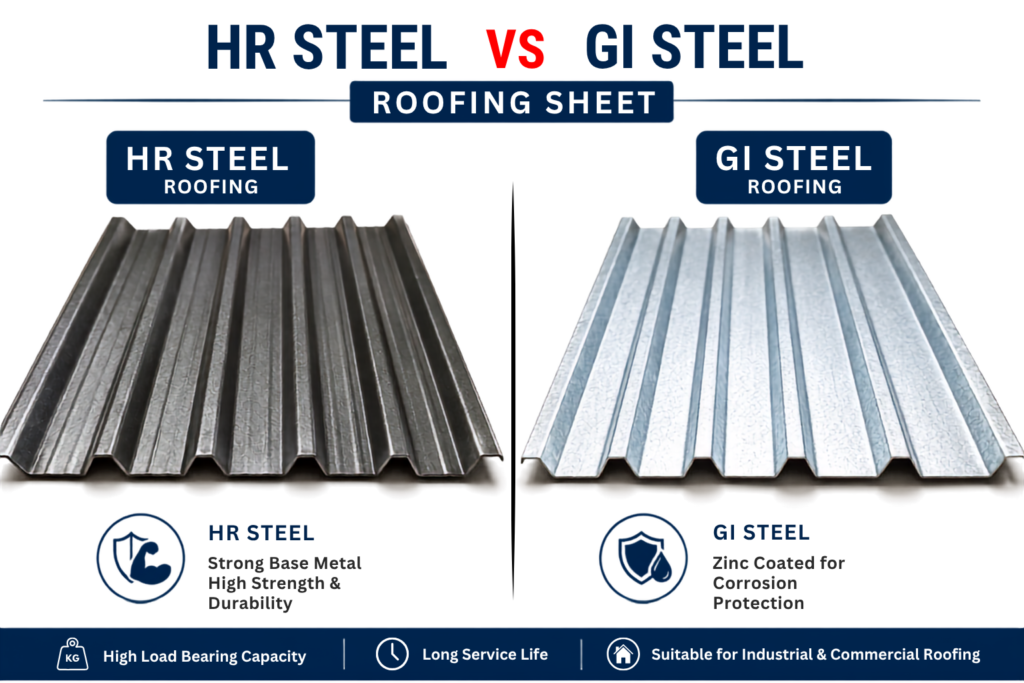
GI Steel is very good for normal roofing purposes due to its anti-corrosive nature due to the zinc coating. Builders extensively use it in residential, commercial, and industrial structures.
HR Steel
Engineers apply HR steel for making robust structural components like PEB structures, columns, beams, and industrial fabrications.
GI vs. Galvalume: Which Is the Better Coating Substrate?
Consumers deciding on metal roofing products usually have to choose between GI sheets and GL sheets. However, the two materials differ from each other in several key aspects beyond their coating composition, including:
GI Sheets (Galvanized): Provide reliable corrosion resistance. They are suitable for typical inland and urban areas.
Galvalume Sheets (PPGL): The aluminum helps provide excellent barrier and heat-reflection properties of heat, and the zinc offers edge protection. Galvalume roofing sheets deliver up to 3–4 times higher durability than conventional GI sheets, making them an excellent choice for coastal and industrial environments where long-term corrosion resistance is critical.
Use GI Steel Where:
- You are looking for an affordable option for your roof.
- Your project requires a regular inland setting.
- You have to consider corrosion protection.
Use HR Steel Where:
- You are constructing the skeleton of the project.
- You are requiring beams, columns, rafters, or PEB members.
- The protective coating keeps the steel protected from direct exposure.
Frequently Asked Questions
1. How Does the Strength of GI Steel Compare with HR Steel?
Strength of GI steel is equal to that of HR steel as GI steel is made by giving zinc coating to the HR steel. The zinc coating does not increase the tensile strength or load-carrying capacity of steel. Instead it acts as a protective barrier that improves corrosion resistance and increases the service life of the steel. The zinc coating only makes the material resistant to corrosion. Majorly HR steel is used for construction purposes like making PEBs, columns, beams, and industrial construction where the strength of the steel and its formability are taken into consideration. However, in the case of galvanized steel, it is employed in manufacturing of roofing sheets owing to its zinc coating.
2. Which material combination should you choose for an industrial shed?
The best combination for an industrial shed is HR steel for the main structural framework and PPGL or PPGI sheets for roofing and cladding. Engineers use HR steel for columns, beams, and rafters because it provides high strength, while PPGL or PPGI sheets offer excellent corrosion resistance and long-term weather protection.
Conclusion
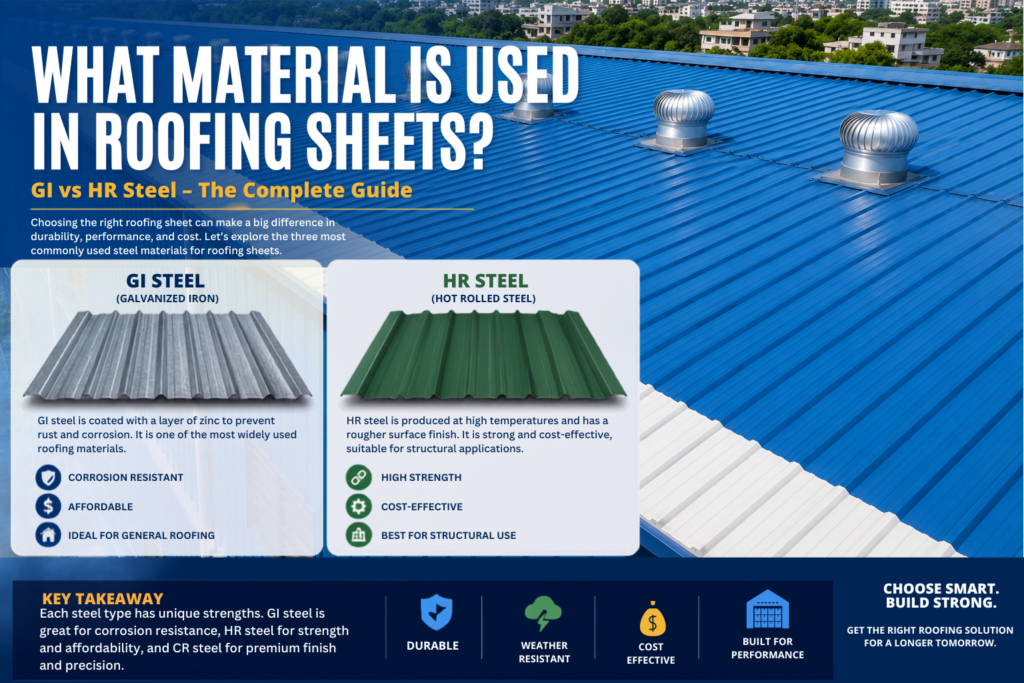
Understanding the properties of roofing sheet materials helps you make the right investment decision. GI steel is an excellent choice for roofing applications because its zinc coating provides reliable corrosion protection. On the other hand, manufacturers use HR steel mainly for structural components such as columns, beams, and frames rather than exposed roofing.
For long-lasting roofing performance, choose sheets made from high-quality steel with protective coatings such as Galvanized (GI) or Galvalume (GL/PPGL). These materials provide excellent strength, superior weather resistance, corrosion protection, and extended service life for residential, commercial, and industrial projects.
Why Choose Bhagwati Roofing Products?
Premium roofing and construction solutions are provided by Bhagwati Roofing Products throughout India, which include:
- PPGL Roofing Sheets
- PPGI Roofing Sheets
- Galvalume Roofing Sheets
- GI Roofing Sheets
- Aluminum Roofing Sheets
- Deck Sheets
- C & Z Purlins
- Turbo Ventilators
- Roofing Flashings and Accessories
We use high-quality steel and advanced coating technologies to manufacture durable roofing products that deliver reliable performance, long service life, and excellent value for industrial, commercial, agricultural, and residential projects.
Contact Bhagwati Roofing Products today for expert guidance and a customized quotation for your roofing requirements.
1. What is the base material used for roofing sheets?
The base material used for most steel roofing sheets is cold-rolled steel, which is then coated with zinc (GI) or an aluminum-zinc alloy (Galvalume) for corrosion protection. Plain HR (Hot Rolled) steel is generally not used for exposed roofing because it rusts quickly without a protective coating.
2. Is GI steel stronger than HR steel?
No. GI steel is not stronger than HR steel. Galvanized (GI) steel has almost the same mechanical strength as its underlying steel substrate. The zinc coating improves corrosion resistance, not structural strength.
3. Why is GI steel preferred for roofing sheets?
GI steel is preferred because its zinc coating protects the steel from rust and corrosion, resulting in a longer service life, lower maintenance, and better performance in outdoor environments.
4. Can HR steel be used for roofing sheets?
Plain HR steel is not recommended for exposed roofing applications because it corrodes rapidly when exposed to moisture and air. However, HR steel is widely used in structural applications such as PEB frames, columns, beams, and trusses.
5. What is the difference between GI and HR steel?
The main difference is the protective coating. GI steel has a zinc coating that resists corrosion, while HR steel is uncoated structural steel designed primarily for fabrication and load-bearing applications.
6. Which roofing material lasts longer: GI or PPGL?
PPGL roofing sheets generally last longer than GI roofing sheets. Their aluminum-zinc alloy coating offers superior corrosion resistance and better heat reflectivity, making them ideal for coastal, industrial, and high-humidity environments.
7. What is the best roofing sheet for industrial sheds?
For industrial sheds, the recommended combination is:
- HR steel for the structural framework
- PPGL or PPGI roofing sheets for the roof and wall cladding
This combination provides high structural strength and excellent corrosion resistance.